
Weapon Classification
Designed expandable logic that reads a weapon's items, structure, dimensions, and balance to identify its family and archetype.
Soft Things Hit Hard is a third-person party mini-royale for 4–8 players. Squishy play-doh creatures scavenge an oversized school desk, snap everyday junk together into weapons, attach protection to their bodies, and fight to become the last blob standing.
Designed expandable logic that reads a weapon's items, structure, dimensions, and balance to identify its family and archetype.
Defined nine distinct archetypes with different attack motions, ranges, damage profiles, timing, and intended player behaviors.
Built a non-transitive matchup system so every weapon has favorable and unfavorable opponents without creating automatic wins.
The weapon-building system and combat experience are the core of Soft Things Hit Hard. The game's fun comes from combining competitive combat with chaotic party-game moments. Its central premise is that anything players build should be easy to understand, distinct in combat, and memorable to fight with.
Because players can assemble almost any combination of junk, the game cannot rely on a fixed list of prebuilt weapons. The classification system bridges building and combat by recognizing each construction and assigning it an archetype whose attacks, range, and matchup role feel intuitive from its visible structure.
This makes reliable classification essential to the combat design. Every archetype needs a meaningful role and a fair set of favorable and unfavorable matchups. The system lets unpredictable player creations enter those relationships consistently, giving players freedom to experiment without sacrificing clarity, uniqueness, or balance.
I designed a two-layer algorithm that first identifies a weapon family and then determines the specific archetype inside that family. This turns an open-ended building system into combat logic that remains readable for players and expandable for development.
Here are a few examples of different weapon archetypes (recognized by the game system in the debug overlay on the right side of each screenshot):
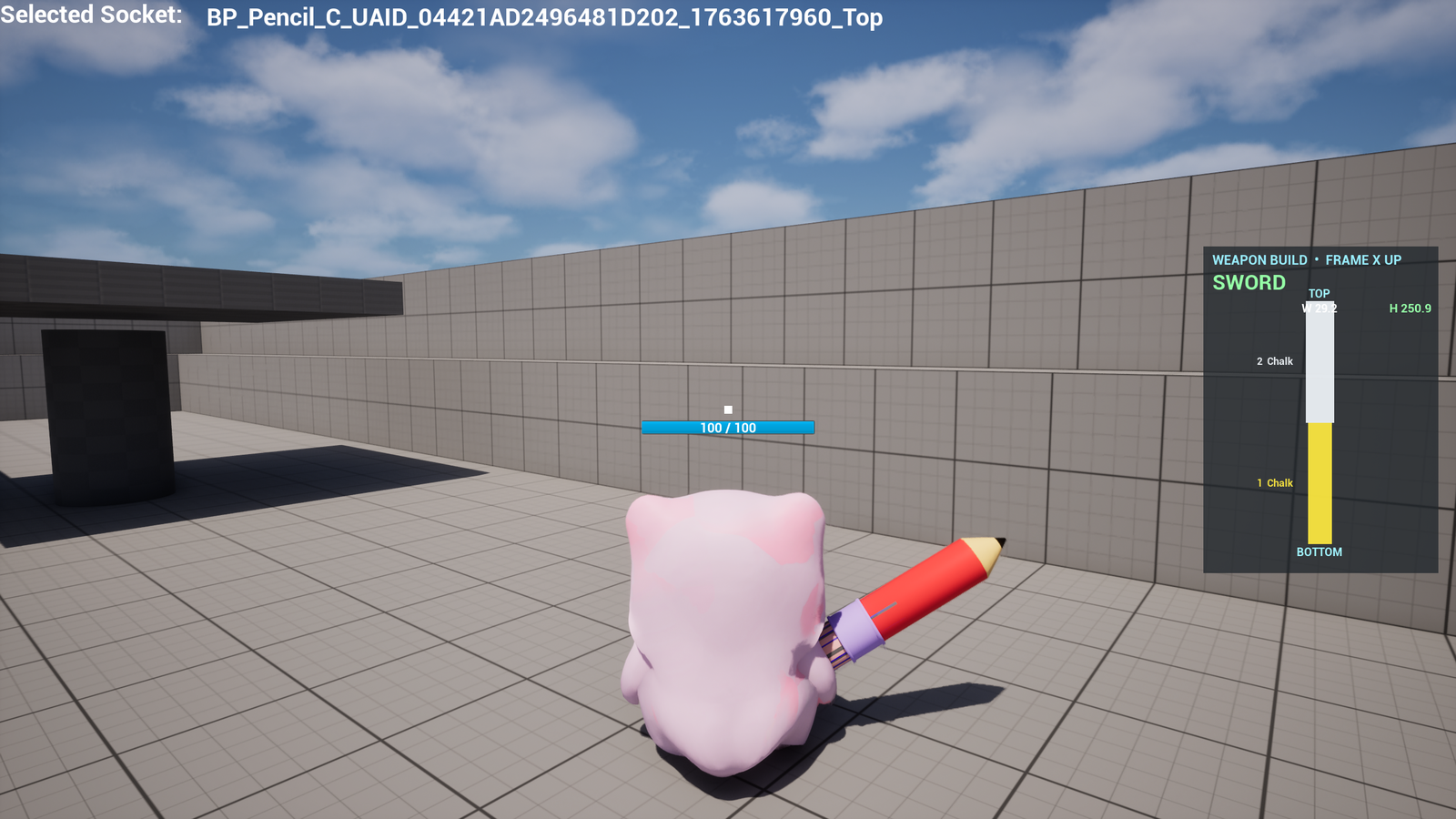
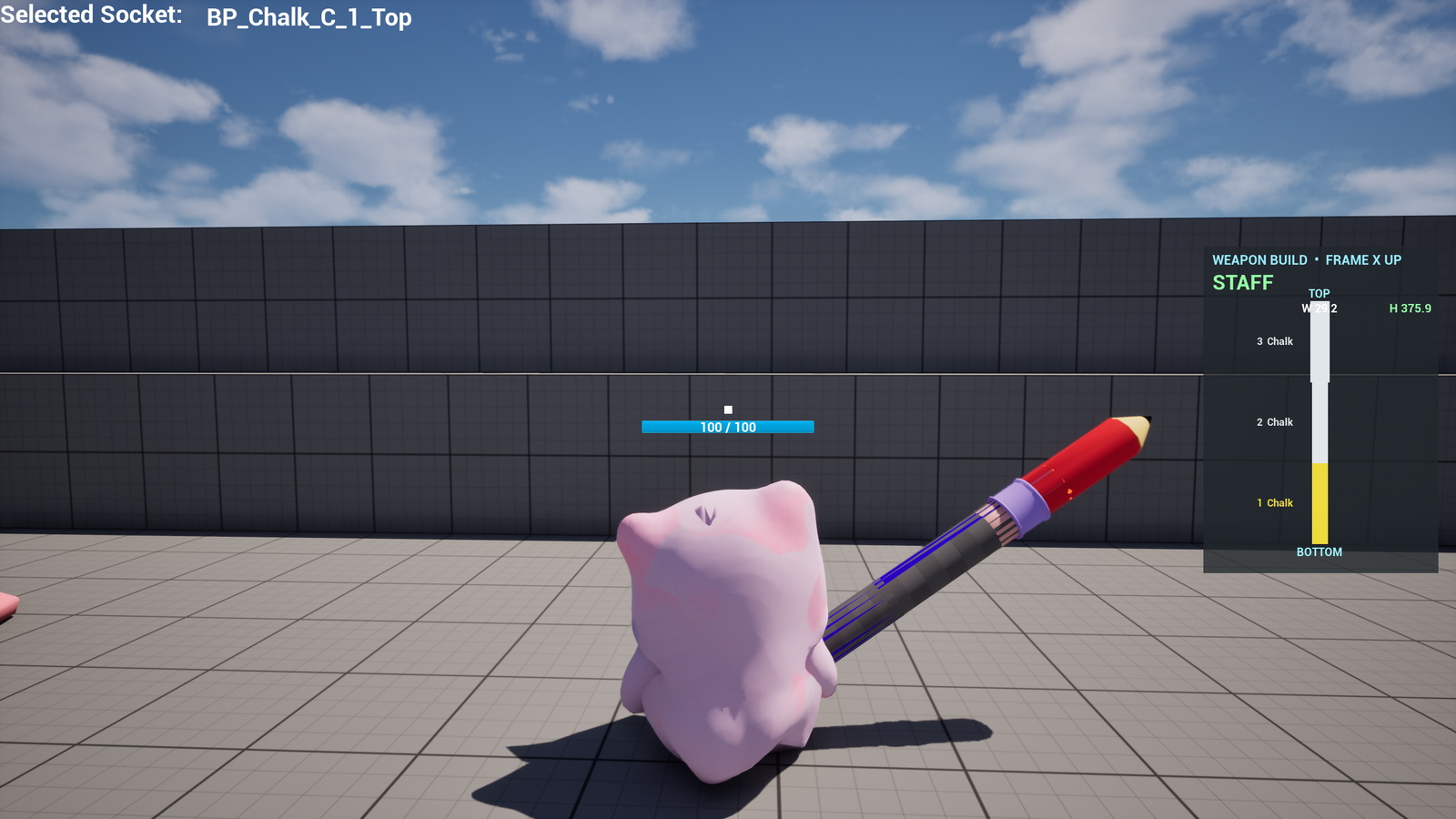
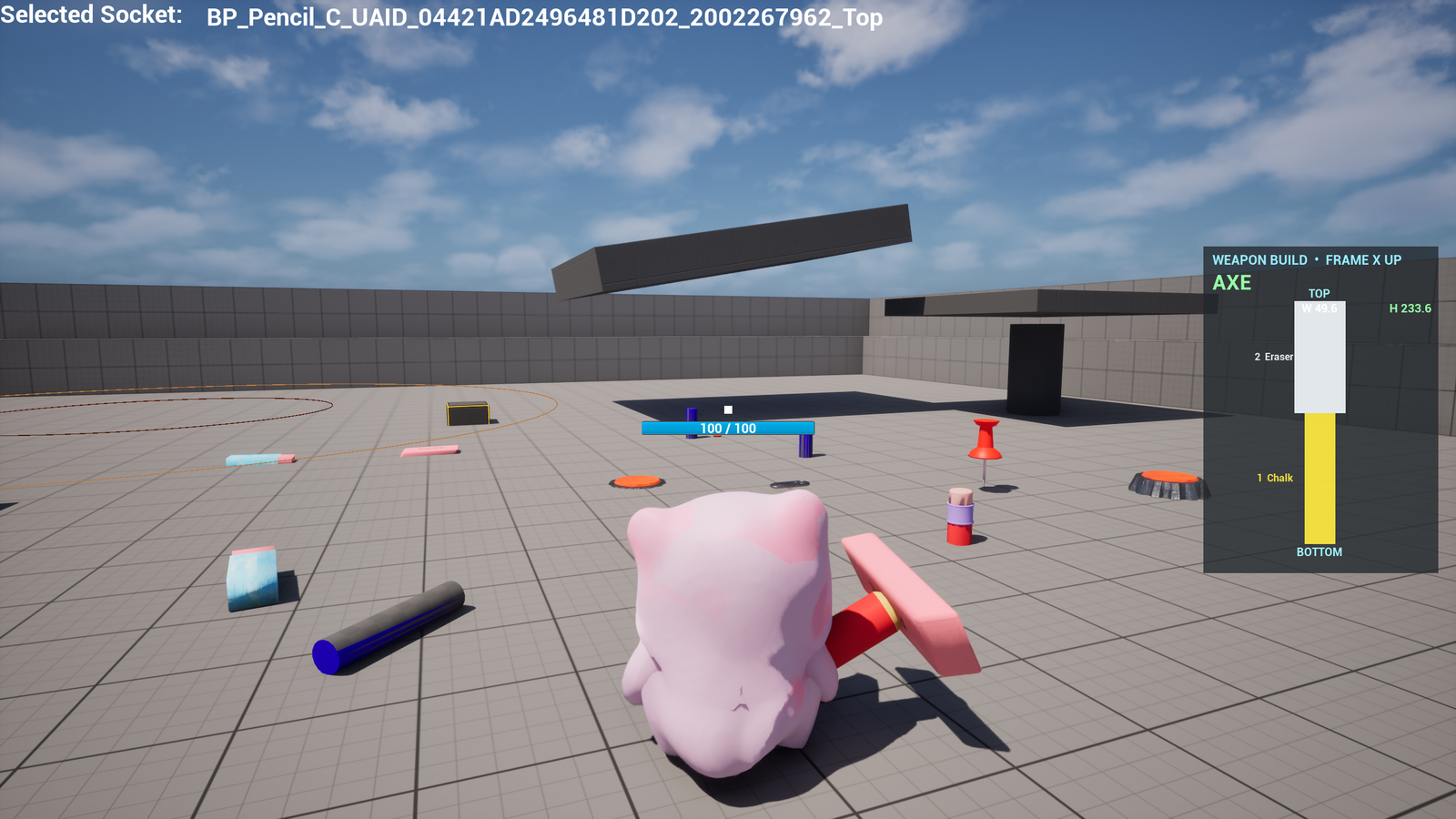
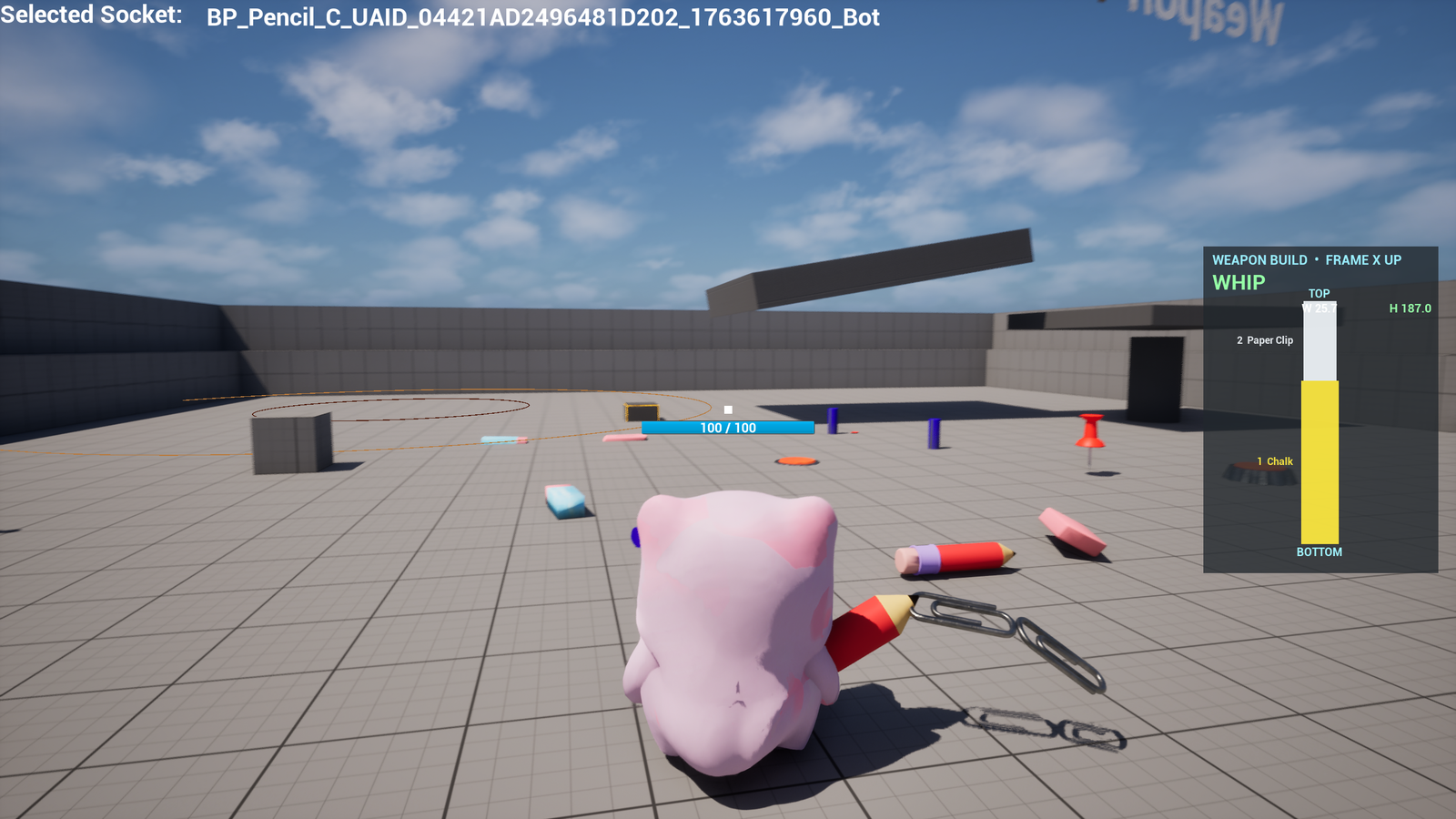
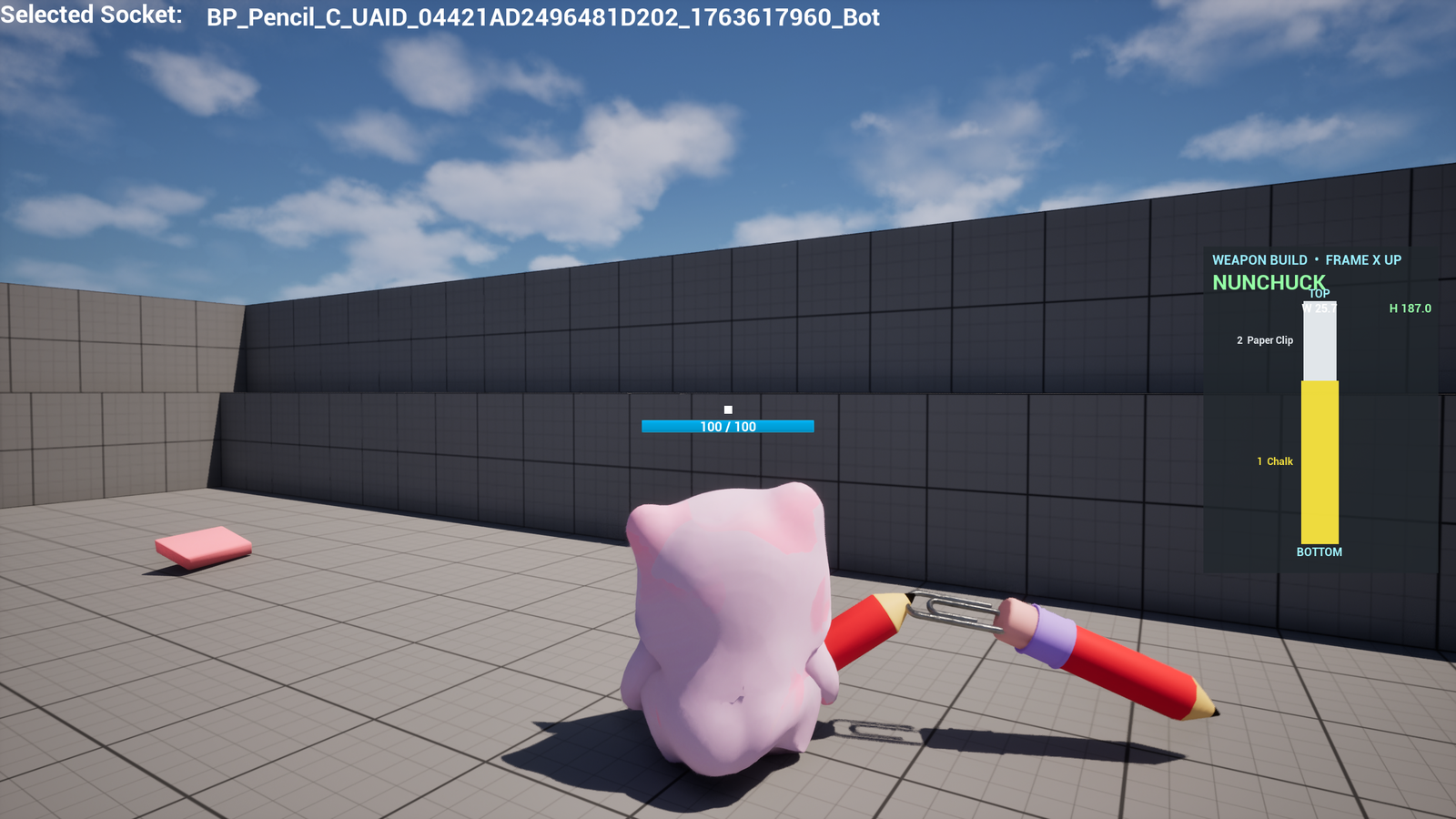
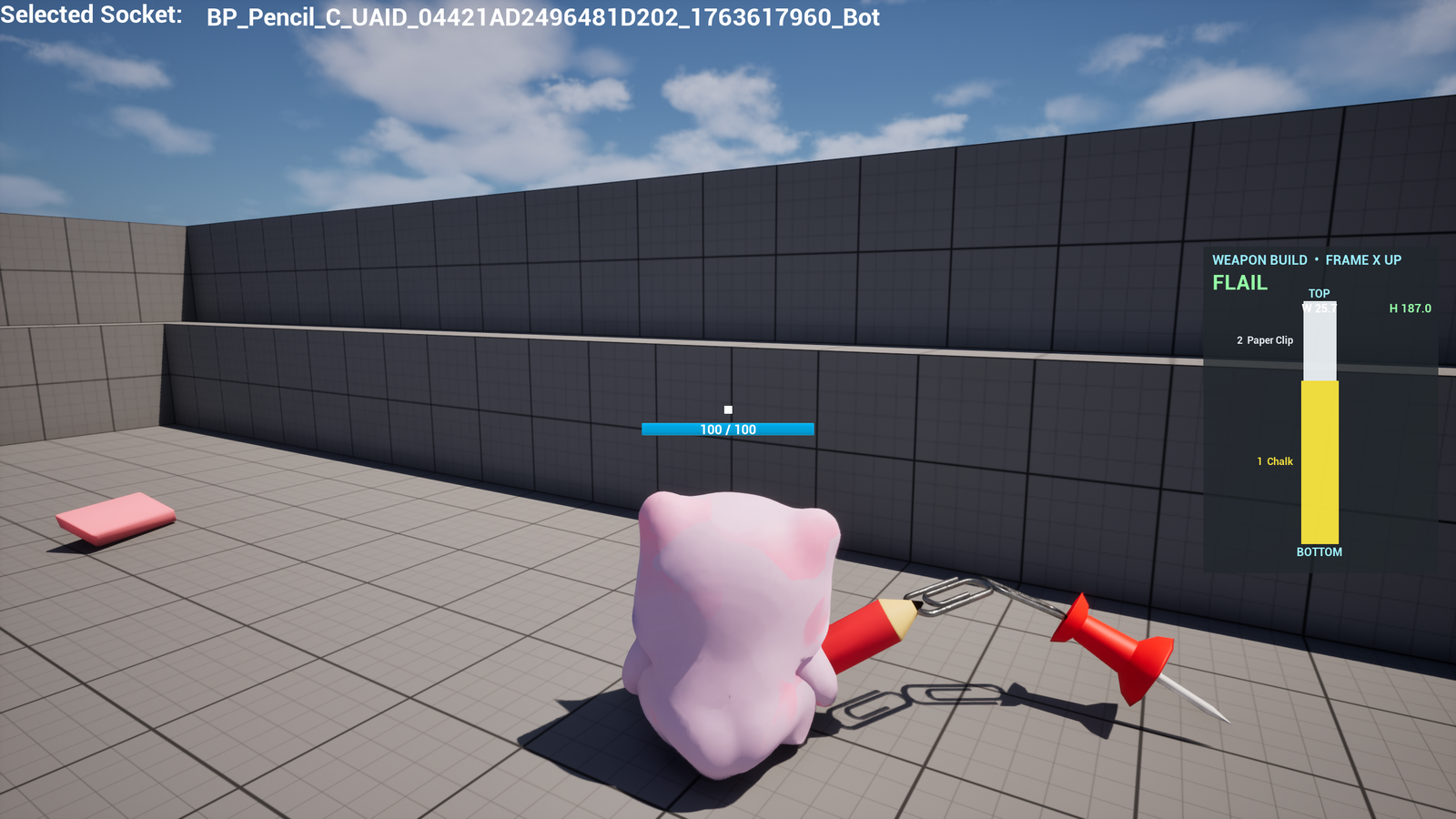
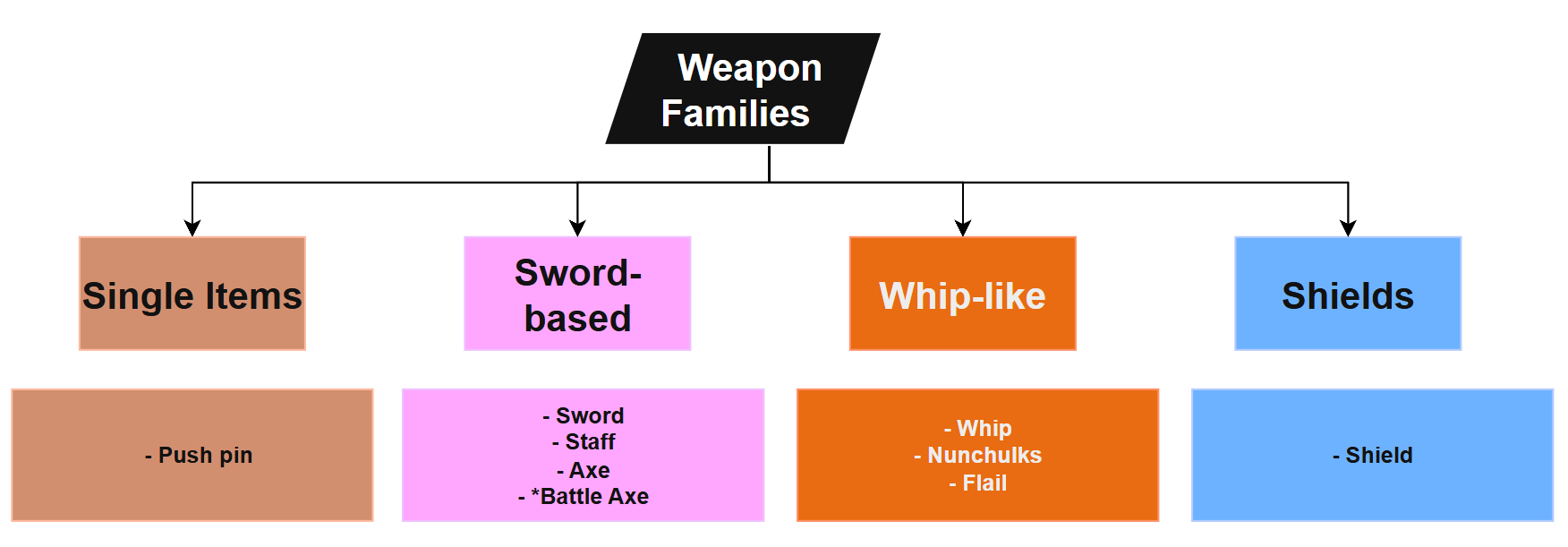
I began by comparing how different weapons are physically related. I found that many archetypes could be grouped through shared construction features: a Staff is a longer Sword, an Axe is a Sword with a wide horizontal top, and a Battle Axe applies the same relationship to a longer weapon. Whip-like weapons share a loose connector, while Shields can be identified by their base item.
This makes it easier to design a system that checks specific conditions to determine an archetype within a family, since every weapon in that family is somehow related.
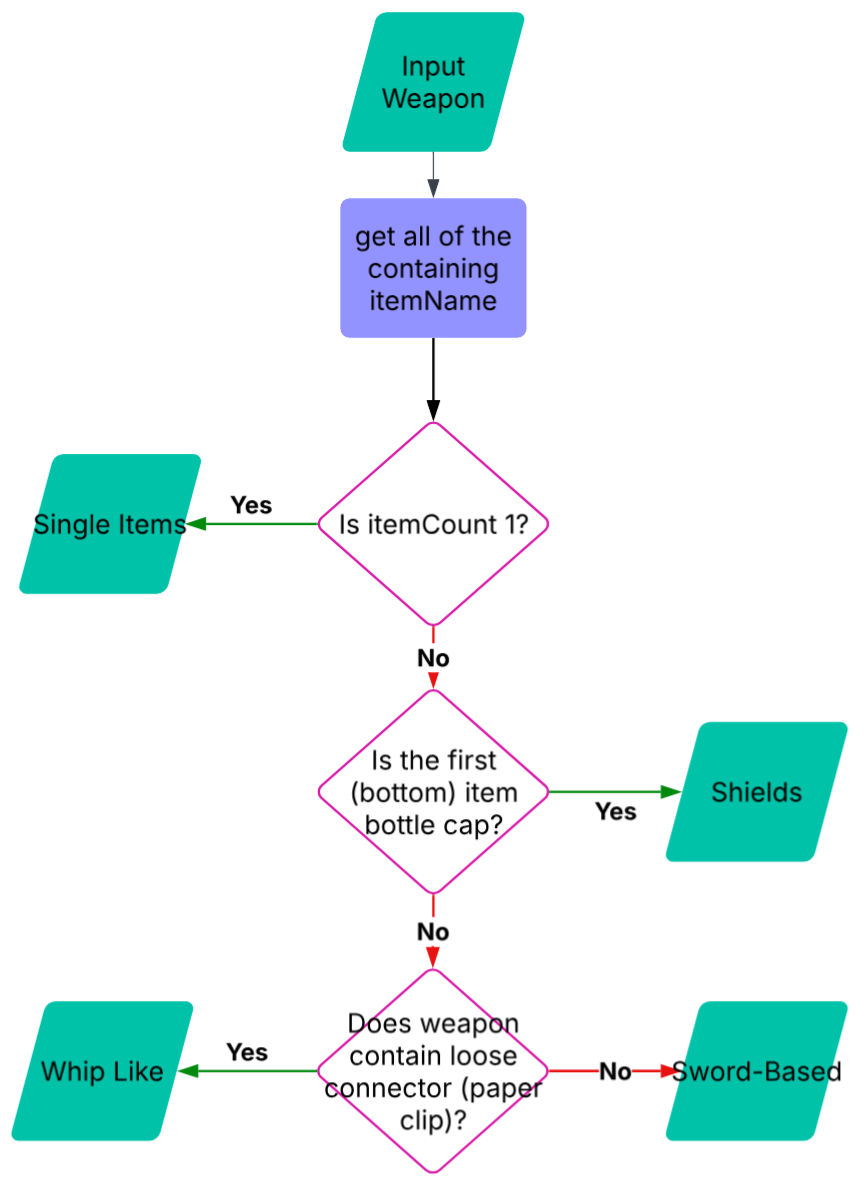
The system first collects every connected item. A single item resolves immediately; a multi-item build is then checked for a Shield base and the position of any loose connector. The remaining builds enter the Sword-Based family.
I separated these checks into independent family logic so one family can be expanded or adjusted without rewriting the entire classification system.
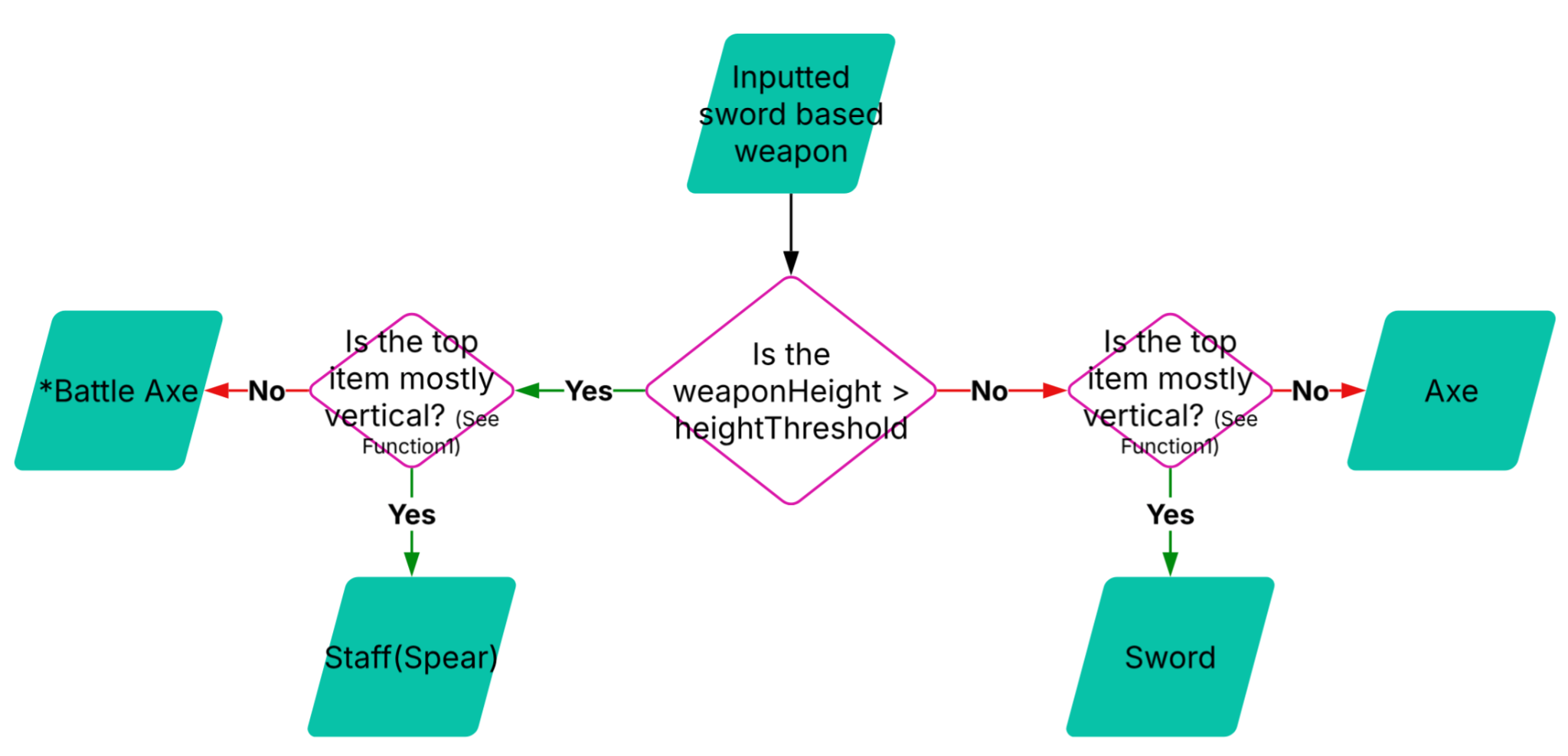
I created this diagram to help the engineering team understand the design structure and classification logic.
Once the family is known, the system evaluates only the features relevant to that family. For sword-based weapons, total height separates short weapons from long weapons, while the top item's geometric profile separates vertical shapes from wide shapes. Those two checks produce Sword, Staff or Spear, Axe, and Battle Axe.
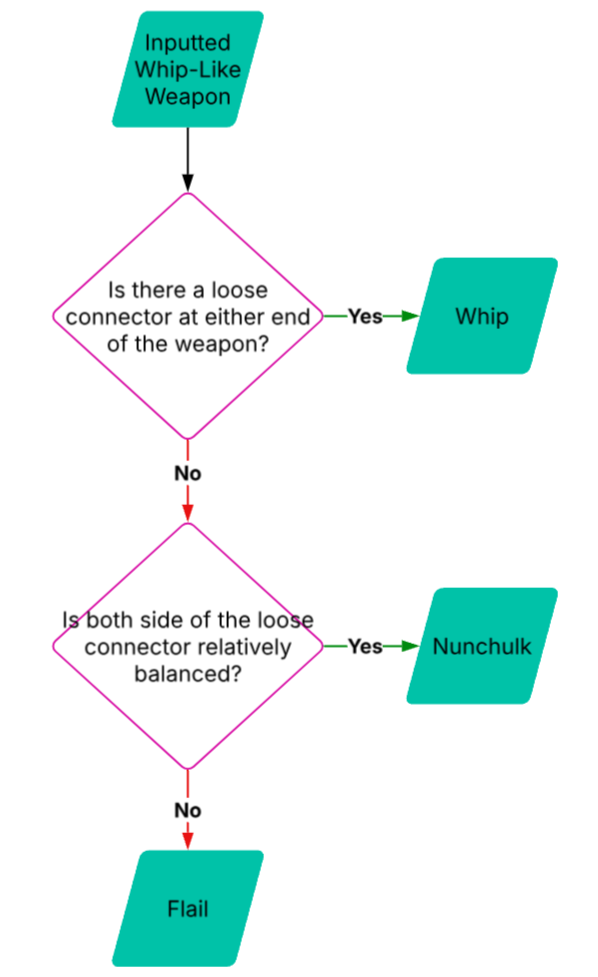
A loose connector at either end creates a Whip. When the connector sits between two weapon segments, the system instead compares the weight on both sides.
A relatively balanced construction becomes Nunchucks, while an unbalanced construction becomes a Flail. This lets the weapon's visible structure communicate its combat behavior.
I created this diagram to help the engineering team understand the design structure and classification logic.
I translated the design into explicit inputs and tunable thresholds so engineering could implement the system without hard-coding every possible weapon combination.
| Input | What It Measures | Design Use |
|---|---|---|
| Item count and location | Number and order of connected objects | Identifies single items, exposed connectors, and structural positions. |
| Height, width, and length | The weapon's local geometric profile | Separates short from long weapons and vertical tops from wide tops. |
| Item weight | Mass on each side of a connector | Distinguishes balanced Nunchucks from an unbalanced Flail. |
| Tunable thresholds | Height, shape ratio, and balance offsets | Allows iteration without rebuilding the classification structure. |
My first design goal was to create a balanced, intuitive, and fair counter system that beginners could understand without a large learning curve. My second goal was to give every weapon family and archetype a distinct, meaningful combat role rather than making the weapons feel like statistical variations of one another.
I started with the motion and physical structure of each archetype, then defined its ideal range, pressure pattern, damage, wind-up, recovery, and attack rate. Those behaviors established the strengths and weaknesses used to design the matchup relationships.
I used each combat role to build a non-transitive soft-counter system. Range-control weapons punish short-range attackers; fast pressure weapons exploit slow, high-commitment attacks; flexible weapons can bypass frontal defense; and heavy power weapons can break Shields. Every archetype has favorable and unfavorable matchups, but an advantage is never intended to become an automatic win.
This matrix is the original specification for the intended combat relationships between weapon archetypes. Each ratio compares the weapon named on the left with the weapon named at the top. For example, Staff versus Sword at 6 / 4 means Staff is designed to hold an advantage in that matchup.
| Left / Top | Sword | Staff | Spear | Axe | B. Axe | Whip | Nunch. | Flail | Shield |
|---|---|---|---|---|---|---|---|---|---|
| Sword | N | ||||||||
| Staff | 6 / 4 | N | |||||||
| Spear | 7 / 3 | 5 / 5 | N | ||||||
| Axe | 5 / 5 | 4 / 6 | 3 / 7 | N | |||||
| B. Axe | 6 / 4 | 6 / 4 | 6 / 4 | 6 / 4 | N | ||||
| Whip | 3 / 7 | 3 / 7 | 6 / 4 | 7 / 3 | 3 / 7 | N | |||
| Nunch. | 6 / 4 | 6 / 4 | 2 / 8 | 5 / 5 | 7 / 3 | 7 / 3 | N | ||
| Flail | 4 / 6 | 6 / 4 | 7 / 3 | 4 / 6 | 5 / 5 | 7 / 3 | 2 / 8 | N | |
| Shield | 8 / 2 | 6 / 4 | 6 / 4 | 3 / 7 | 1 / 9 | 2 / 8 | 8 / 2 | 2 / 8 | N |